
Engineer Goby
Engineer Goby
Couldn't load pickup availability
Engineer Goby (Pholidichthys leucotaenia) – Unique Black and Yellow Saltwater Burrowing Fish
The Engineer Goby is a fascinating saltwater aquarium fish known for its striking juvenile coloration, eel-like adult appearance, and remarkable burrowing behavior. Also commonly called the Engineer Blenny or Convict Blenny, this unusual marine species is an excellent choice for aquarium enthusiasts looking for a distinctive fish with interesting natural behaviors.
Scientifically known as Pholidichthys leucotaenia, the Engineer Goby belongs to the family Pholidichthyidae. Despite its common names, it is not a true goby or blenny.
Native to tropical marine environments throughout the western Pacific Ocean, including Indonesia, the Philippines, and surrounding reef systems, the Engineer Goby is especially recognized for its ability to construct elaborate tunnels beneath rocks and sandy substrates.
One of the most interesting characteristics of the Engineer Goby is the dramatic transformation it undergoes as it matures.
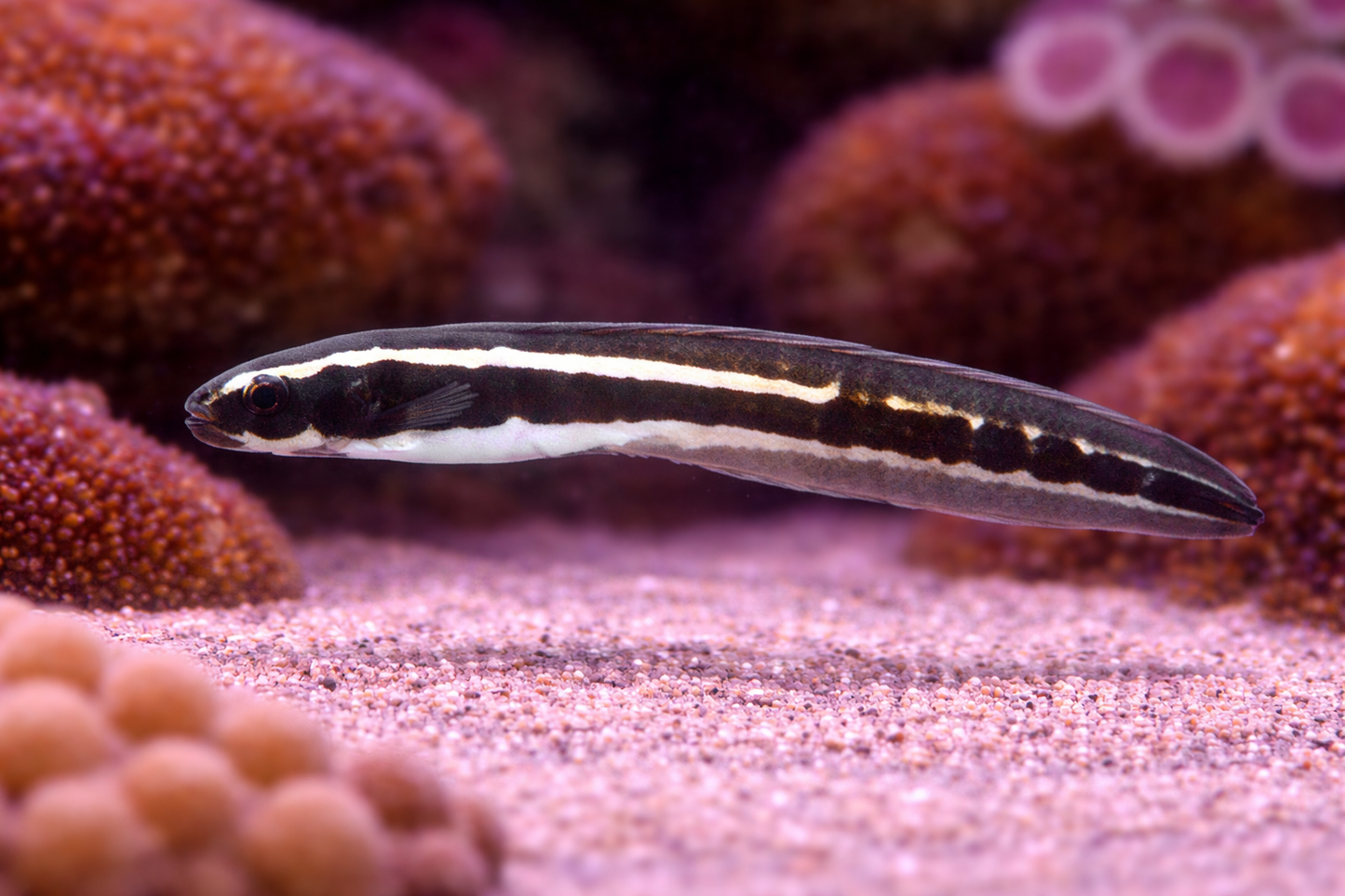
Juvenile Engineer Gobies typically display a dark black body with a bright yellow horizontal stripe extending along the length of the fish. This coloration resembles certain marine catfish and may help provide protection from predators.
As the fish matures, its coloration gradually changes into a distinctive black-and-white or dark-and-cream barred pattern.
Adult Engineer Gobies develop an elongated, eel-like body that makes them particularly unusual among commonly available marine aquarium fish.
Although they resemble eels, Engineer Gobies are a separate species with their own unique behaviors and care requirements.
Engineer Gobies are best known for their extensive digging and tunnel-building activities.
They naturally excavate burrows beneath rocks and other structures, creating underground networks that provide shelter and protection.
This fascinating behavior makes them entertaining to observe, but it also requires careful aquarium preparation.
Because Engineer Gobies can move significant amounts of substrate, live rock and aquarium decorations must be securely positioned to prevent shifting or collapse.
Engineer Gobies are generally peaceful toward appropriately sized marine fish and can coexist with many community aquarium species.
However, they may consume very small fish or crustaceans that can fit into their mouths, particularly as they grow larger.
Unlike many small marine aquarium fish, Engineer Gobies can reach approximately 12 inches or more in length as adults.
Their substantial adult size and active burrowing behavior make them better suited for larger, established saltwater aquariums with appropriate substrate and secure rockwork.
A minimum aquarium size of 55 gallons is recommended for a single Engineer Goby, with 75 gallons or larger preferred for long-term care.
With its dramatic color transformation, fascinating tunneling behavior, and unusual eel-like appearance, the Engineer Goby is an outstanding addition to a properly designed marine aquarium.
Product Specifications
Scientific Name: Pholidichthys leucotaenia
Common Name: Engineer Goby, Engineer Blenny, Convict Blenny
Family: Pholidichthyidae
Fish Type: Marine Burrowing Fish
Care Level: Moderate
Temperament: Generally Peaceful; May Consume Very Small Fish or Crustaceans
Diet: Carnivore
Adult Size: Approximately 12 Inches or More
Minimum Tank Size: 55 Gallons
Recommended Tank Size: 75 Gallons or Larger
Temperature: 74–80°F (23–27°C)
Recommended pH: 8.1–8.4
Specific Gravity: 1.023–1.026
Salinity: Approximately 35 ppt
Water Flow: Moderate
Water Conditions: Clean, Stable, Well-Oxygenated Saltwater
Recommended Setup: Established Saltwater Aquarium with Deep Sand Bed and Secure Rockwork
Substrate: Sand or Fine, Smooth Marine Substrate Suitable for Burrowing
Swimming Level: Bottom Dweller; Frequently Occupies Underground Burrows
Compatibility: Peaceful Marine Community Fish of Appropriate Size
Reef Compatibility: Reef Safe with Caution
Coral Compatibility: Does Not Normally Eat Corals; Burrowing May Disturb or Bury Corals
Shrimp Compatibility: Larger Shrimp May Be Compatible; Very Small Shrimp May Be at Risk
Origin: Western Pacific Ocean, Including Indonesia and the Philippines
Breeding: Egg Layer; Captive Breeding Is Uncommon
Lifespan: Commonly 5–10 Years or Longer with Proper Care
Recommended Experience: Intermediate Saltwater Aquarists
Key Features
-
Beautiful black-and-yellow juvenile coloration
-
Unique black-and-white barred adult appearance
-
Fascinating eel-like body shape
-
Remarkable burrowing and tunnel-building behavior
-
Generally peaceful toward appropriately sized marine fish
-
Interesting natural digging and substrate-moving activities
-
Dramatic coloration changes as the fish matures
-
Excellent addition to larger marine aquariums
-
Readily accepts many frozen and prepared marine foods
-
Often establishes an elaborate underground tunnel system
-
Unusual appearance that stands out from traditional reef fish
-
Long-lived marine species with proper aquarium care
Aquarium Setup and Care Requirements
Aquarium Size: Provide a minimum 55-gallon aquarium for a single Engineer Goby. A 75-gallon or larger aquarium is preferred for long-term care, especially as the fish approaches its adult size.
Aquascaping: Include substantial live rock, caves, and open sandy areas. All rock structures must be securely positioned because Engineer Gobies may excavate sand beneath them.
Substrate: Provide a sand bed approximately 3–4 inches deep or deeper in suitable areas to accommodate natural burrowing behavior. Fine to moderately coarse, smooth marine sand is recommended.
Rock Stability: Position major rock structures directly on the aquarium bottom or on stable supports before adding sand. Avoid balancing heavy rocks on loose substrate.
Live Rock: Established live rock provides natural shelter, biological filtration, and suitable structures for tunnel construction.
Lighting: Standard marine aquarium lighting is suitable. Specialized lighting is only required when maintaining corals or other photosynthetic organisms.
Filtration: Use efficient biological and mechanical filtration to maintain excellent water quality.
Water Movement: Moderate circulation is suitable, with sheltered areas available around burrow entrances.
Diet: Feed a varied carnivorous diet containing frozen mysis shrimp, chopped marine shrimp, krill, and other appropriately sized marine foods.
Tankmates: Suitable companions may include larger Clownfish, Cardinalfish, certain Wrasses, Tangs, and other peaceful marine species that cannot easily be swallowed.
Water Chemistry: Maintain stable salinity, temperature, pH, and alkalinity.
Water Quality: Perform regular partial water changes and maintain ammonia and nitrite at zero.
Burrowing Behavior: Expect regular substrate movement and tunnel excavation. Engineer Gobies may rearrange portions of the aquarium's sand bed.
Long-Term Care: Provide adequate space, secure rockwork, consistent feeding, and stable marine water conditions.
Feeding and Nutrition
Engineer Gobies are carnivorous marine fish that naturally consume small crustaceans, zooplankton, and other available animal-based food sources.
In captivity, they readily accept a variety of frozen and prepared marine aquarium foods once acclimated.
Recommended foods include:
-
Frozen mysis shrimp
-
Enriched frozen brine shrimp
-
Finely chopped marine shrimp
-
Chopped clam
-
Small pieces of marine fish
-
Appropriately sized frozen krill
-
High-quality sinking marine carnivore pellets
-
Frozen marine plankton preparations
-
Other suitable protein-rich marine foods
Juvenile Engineer Gobies should receive appropriately sized foods that can be easily consumed.
As they grow, larger food items may be introduced to accommodate their increasing size.
Engineer Gobies often emerge from their burrows during feeding and may quickly retreat after collecting food.
Some individuals become especially active during feeding periods or under dimmer lighting conditions.
A varied diet helps support healthy growth, proper body condition, immune function, and long-term vitality.
Feed small portions once or twice daily, adjusting according to the fish's size and nutritional needs.
Avoid overfeeding, as uneaten food can accumulate within the substrate and contribute to poor water quality.
Unique Burrowing and Engineering Behavior
One of the most fascinating characteristics of the Engineer Goby is its ability to construct extensive underground tunnels.
In natural marine environments, Engineer Gobies excavate burrows beneath rocky structures and sandy substrates.
These tunnels provide shelter from predators and create protected resting areas.
In captivity, Engineer Gobies display similar behavior by moving sand with their mouths and excavating pathways beneath aquarium rockwork.
Over time, they may create an elaborate network of tunnels with multiple entrances.
This behavior is the reason behind the common name Engineer Goby.
Although entertaining to observe, their digging activities can significantly alter aquarium aquascaping.
Loose rocks may shift or collapse if their supporting substrate is removed.
For this reason, all major rock formations should be secured before introducing an Engineer Goby.
Aquarium owners should also expect sand to be deposited in new areas as the fish continues its excavation activities.
Providing an appropriately deep substrate and stable rock structures allows the Engineer Goby to display its natural behavior more safely.
Juvenile and Adult Coloration
Engineer Gobies undergo one of the most interesting appearance changes among commonly available marine aquarium fish.
Juvenile Coloration: Young Engineer Gobies typically display a dark black body with a bright yellow horizontal stripe extending from the head toward the tail.
This distinctive appearance makes juveniles especially attractive and easily recognizable.
Adult Coloration: As the fish matures, the yellow stripe gradually disappears and is replaced by a series of pale vertical bars or irregular markings against a dark body.
Adults develop an elongated appearance that resembles certain marine eels.
This transformation makes Engineer Gobies particularly interesting for aquarium enthusiasts who enjoy observing the development of marine fish over time.
Individual coloration and pattern intensity may vary depending on age, maturity, lighting, and overall health.
Temperament and Compatibility
Engineer Gobies are generally peaceful marine fish that spend much of their time within or near their burrows.
They are not typically aggressive toward unrelated fish, although they may defend their preferred shelter.
Their elongated bodies and relatively large adult size should be considered when selecting tankmates.
Very small fish and crustaceans may be vulnerable to predation, especially from mature Engineer Gobies.
Avoid housing them with tiny ornamental fish or delicate crustaceans that may be mistaken for food.
Suitable companions include many appropriately sized peaceful marine fish that do not compete aggressively for the same hiding spaces.
Engineer Gobies may be maintained individually, and compatible groups are sometimes maintained in sufficiently large aquariums.
However, multiple specimens require adequate space, shelter, and careful monitoring.
Avoid introducing Engineer Gobies into aquariums containing aggressive predatory fish that may harass or injure them.
Reef Compatibility
Engineer Gobies are generally considered reef safe with caution.
They do not normally consume coral tissue or intentionally damage healthy coral colonies.
However, their extensive digging behavior may create problems in certain reef aquarium setups.
As Engineer Gobies excavate tunnels, they may move significant amounts of sand.
This activity can bury low-growing corals, disturb coral fragments, or undermine unsecured rock formations.
Corals positioned directly on the substrate may be particularly vulnerable.
For reef aquariums containing Engineer Gobies, securely attach corals to stable rock structures and avoid placing delicate specimens near active burrow entrances.
Their digging behavior should also be considered when maintaining sand-dwelling invertebrates.
With proper aquarium planning, Engineer Gobies can coexist successfully with many coral species.
However, they are generally better suited for reef systems designed to accommodate active burrowing fish.
Natural Habitat and Behavior
Engineer Gobies naturally inhabit tropical marine environments throughout the western Pacific Ocean.
They are commonly associated with sandy areas near coral reefs, rocky structures, and sheltered marine habitats.
In these environments, they construct extensive underground burrows that provide protection from predators.
Juveniles may form groups and display coordinated swimming behavior near their shelter.
As they mature, Engineer Gobies develop their distinctive elongated body shape and spend considerable time within their tunnel systems.
In home aquariums, they may initially remain hidden while adjusting to their surroundings.
Once comfortable, they often become more visible during feeding periods and may regularly emerge from their burrow entrances.
Their unusual behavior makes them particularly appealing to aquarists interested in natural marine fish activity.
Breeding Information
Engineer Gobies are egg-laying marine fish.
In natural environments, adults reproduce in association with their sheltered burrow systems.
Their reproductive behavior and early development are specialized compared with many commonly maintained marine aquarium fish.
Successfully breeding Engineer Gobies in captivity is uncommon and requires advanced marine aquarium experience.
Maintaining compatible breeding specimens, appropriate environmental conditions, and suitable larval foods presents significant challenges.
A dedicated breeding system would generally be necessary for successful captive propagation.
Special Care Considerations
-
Maintain stable, fully cycled saltwater conditions.
-
Provide a sufficiently deep sand bed for natural burrowing behavior.
-
Secure all major rock formations before adding substrate.
-
Never rely on loose sand to support heavy aquarium rocks.
-
Expect regular digging and substrate rearrangement.
-
Provide adequate aquarium space for the fish's adult size.
-
Offer a varied diet containing high-quality marine proteins.
-
Maintain stable salinity and temperature.
-
Avoid sudden changes in water chemistry.
-
Avoid very small fish or crustaceans that may be consumed.
-
Protect delicate corals from shifting or accumulating sand.
-
Maintain excellent filtration and regular aquarium maintenance.
-
Use careful acclimation when introducing new specimens.
-
Provide natural hiding places and protected resting areas.
-
Maintain a secure aquarium cover to prevent jumping.
-
Monitor feeding behavior during acclimation.
-
Allow newly introduced specimens time to establish their burrows.
Why Choose the Engineer Goby?
The Engineer Goby is a fascinating marine fish that combines unusual coloration, remarkable burrowing behavior, and a distinctive eel-like adult appearance.
Its dramatic transformation from a black-and-yellow juvenile into a black-and-white barred adult makes it one of the more interesting marine fish to observe throughout its development.
Unlike many ornamental marine species, the Engineer Goby actively modifies its environment by constructing elaborate underground tunnel systems.
This remarkable behavior provides aquarium enthusiasts with an opportunity to observe natural marine fish engineering activities.
Its generally peaceful temperament and willingness to accept a variety of marine foods make it an appealing choice for appropriately designed saltwater aquariums.
The Engineer Goby is especially desirable for aquarists who enjoy unusual fish species and fascinating natural behaviors.
Whether you're creating a larger fish-only saltwater aquarium, designing a reef system with secure rockwork, or looking for an unusual marine fish with remarkable digging abilities, the Engineer Goby offers personality, activity, and visual appeal.
If you're searching for a unique saltwater fish with dramatic color changes, fascinating tunnel-building behavior, and an unusual eel-like appearance, the Engineer Goby is an outstanding choice.
Note: This listing refers to the Engineer Goby, Pholidichthys leucotaenia. Despite its common names, it is not a true goby or blenny. This species can reach approximately 12 inches or more as an adult and requires a properly designed aquarium with secure rockwork and adequate substrate for burrowing. Its digging behavior may disturb corals, move sand, or undermine unsecured decorations. Individual size, coloration, and behavior may vary. Photographs may be representative unless the specimen is specifically listed as WYSIWYG (What You See Is What You Get).
Share
Shop More
-
Freshwater Aquarium Fish
Fish ship out on Mondays and Tuesdays to ensure their safety during their...
-
Live Aquatic Plants
Plants ship out on Mondays and Tuesdays to ensure their safety during their...
-
Fish Tank Supplies
All orders are shipped out on Mondays and Tuesdays. Find everything you...
-
Aquariums & Stands
Looking to upgrade your setup? Visit Natural Environment Aquatix in Jacksonville, FL...
